International Activities
International Exchange in India: Visit to Chanakya University, ICA General Assembly, and ICEI Annual Meeting
CONTENTS
Overview of the Visit
Purpose of the Visit
The objectives of this visit were as follows:
- To participate in the ICA General Assembly and the ICEI Annual Meeting
- To give a presentation on Japanese university co-operatives upon invitation from Chanakya University
Schedule
- November 25: Arrival in Bengaluru via Delhi
- November 26: Visit to Chanakya University and presentation
- November 27: Participation in the ICA General Assembly and presentation on Japanese university co-operatives
- November 28: Participation in the ICEI Annual Meeting
- November 29: Participation in voting at the ICA General Assembly
- November 30: Return to Japan
Presentation and Exchange at Chanakya University (November 26)
We visited Chanakya University, located in Bengaluru in southern India, and toured the university’s facilities. Although the university was established only three years ago, we were able to see firsthand how the campus is steadily taking shape across its vast grounds.
As part of a lecture program at Chanakya University, three students gave a presentation on Japanese university co-operatives. The presentation covered the four missions and eight visions of Japanese university co-operatives, as well as their five main areas of activity, including food services and support for students living on their own. The students also introduced the activities of student committees within university co-operatives and spoke about the sense of purpose and fulfillment they gain through their involvement.
Since systems like Japanese university co-operatives do not exist in India, some of the questions touched on themes related to student movements. Despite differences in social and cultural backgrounds, the session provided an opportunity to convey the democratic nature of Japanese university co-operatives to the students and faculty members of Chanakya University.
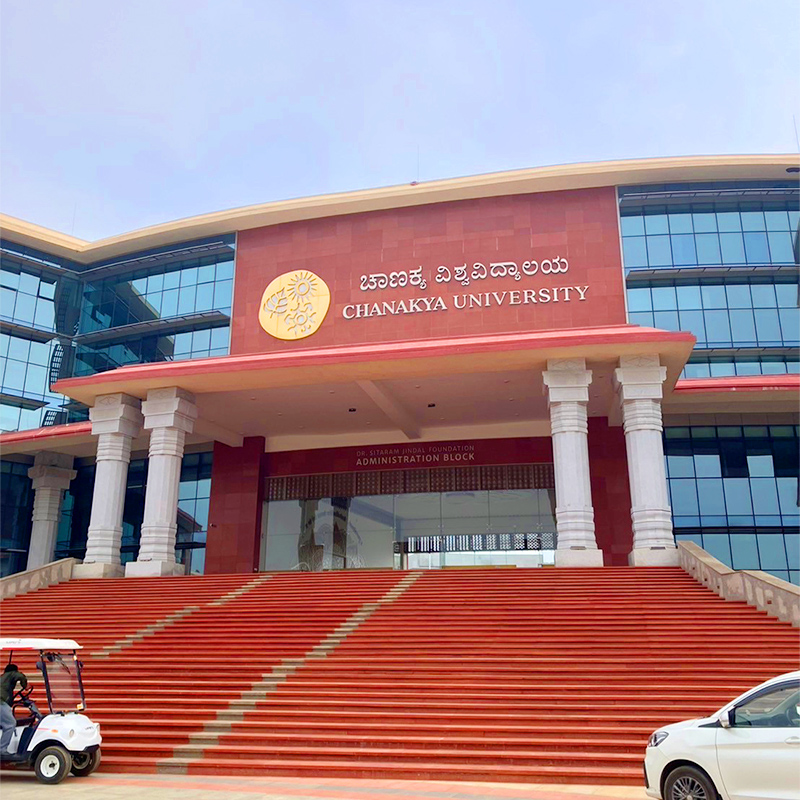
Front view of Chanakya University

A student dormitory resembling an apartment complex
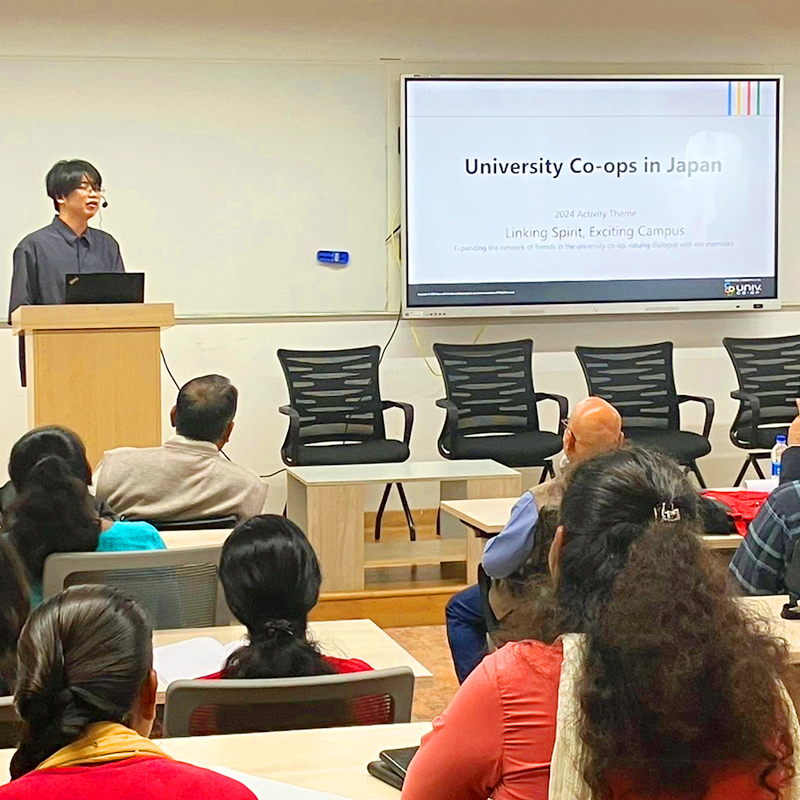
Presentation on Japanese university co-operatives
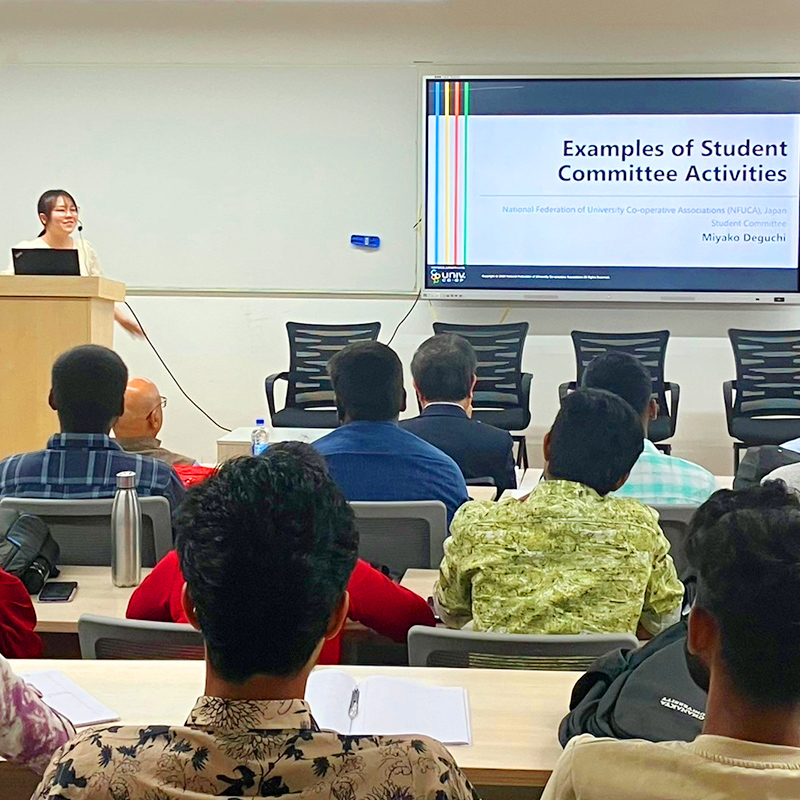
Introducing the activities of the student committee
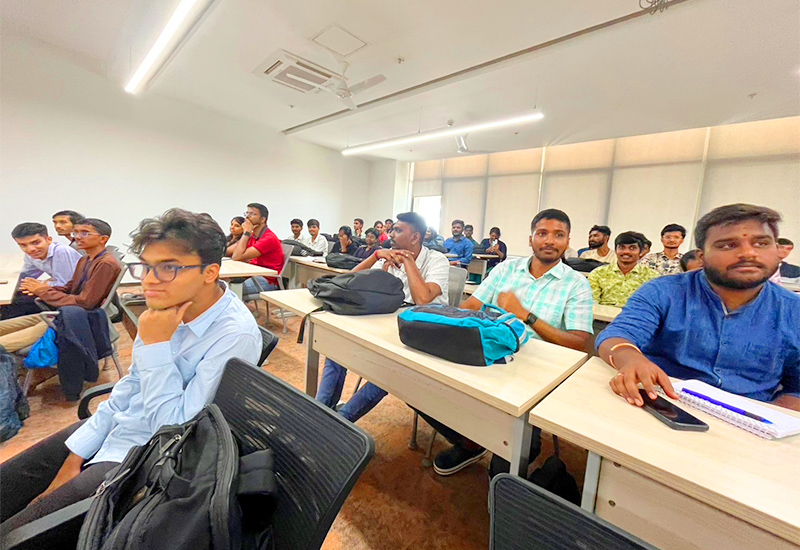
Many students listened attentively to the presentation
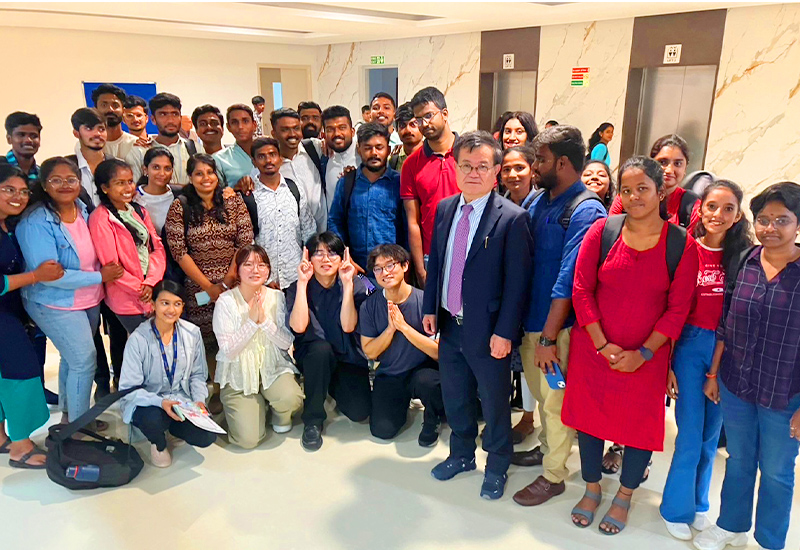
A group photo at the end of the session
ICA General Assembly (November 27–29)
During the ICA General Assembly, representatives of the National Federation of University Co-operative Associations (NFUCA) participated in a thematic session where students introduced the activities of Japanese university co-operatives and shared their experiences as student committee members.
With co-operative representatives gathering from around the world, this session provided an opportunity to highlight the unique nature of Japanese university co-operatives, in which students themselves take a leading role in management and activities. This student-led model attracted considerable interest from participants, many of whom expressed strong curiosity about how such a system operates and is sustained.
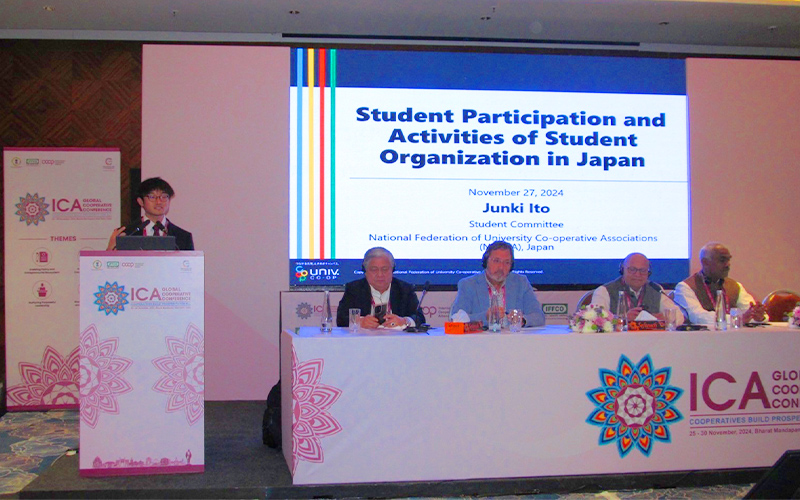
Presentation during a parallel session
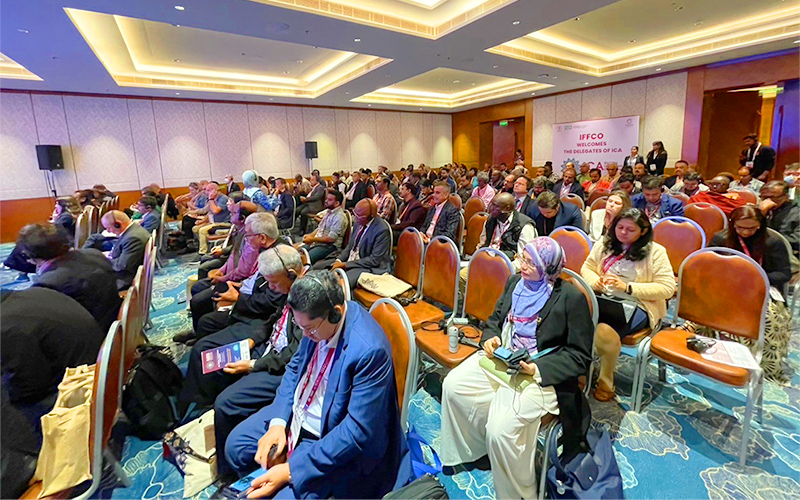
Representatives of co-operatives from around the world
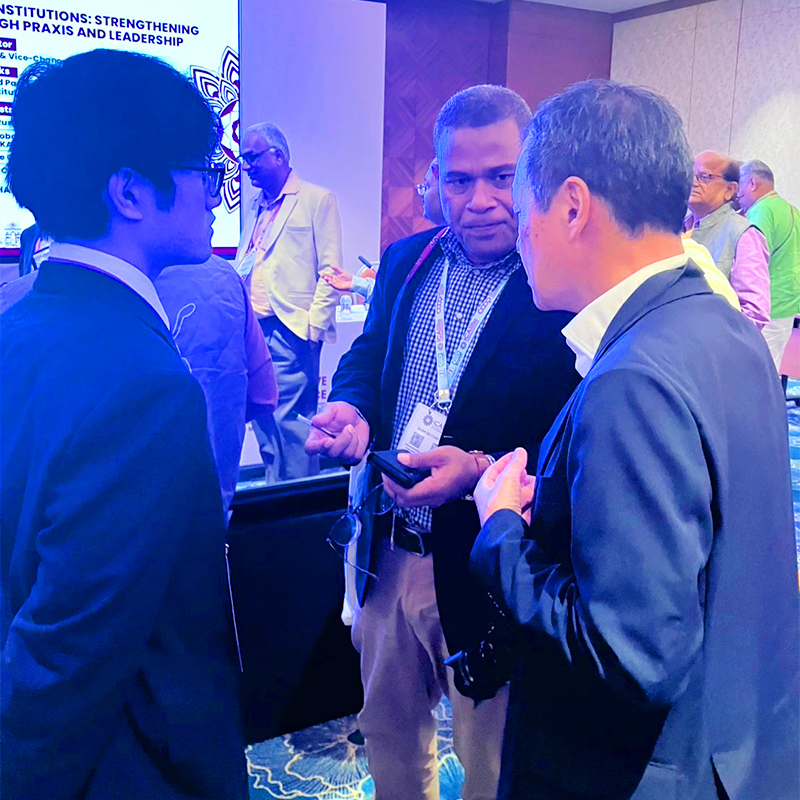
Exchanging views with international participants after the session
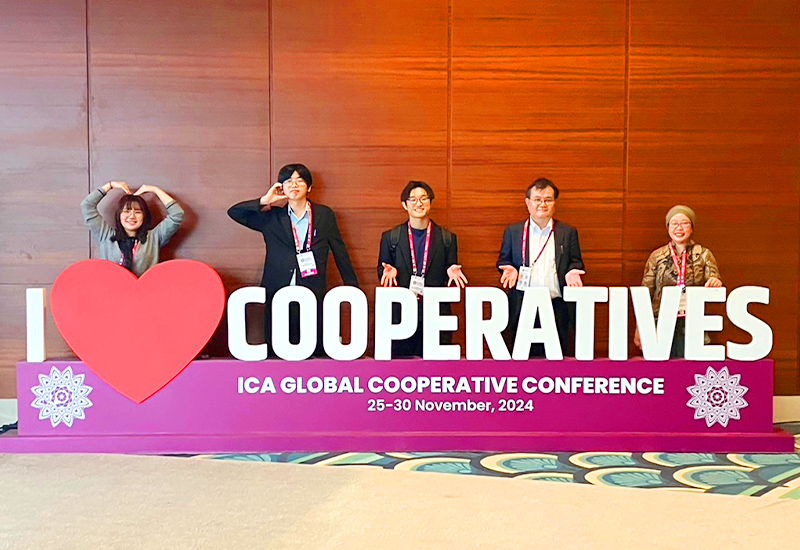
A place filled with passion for co-operatives
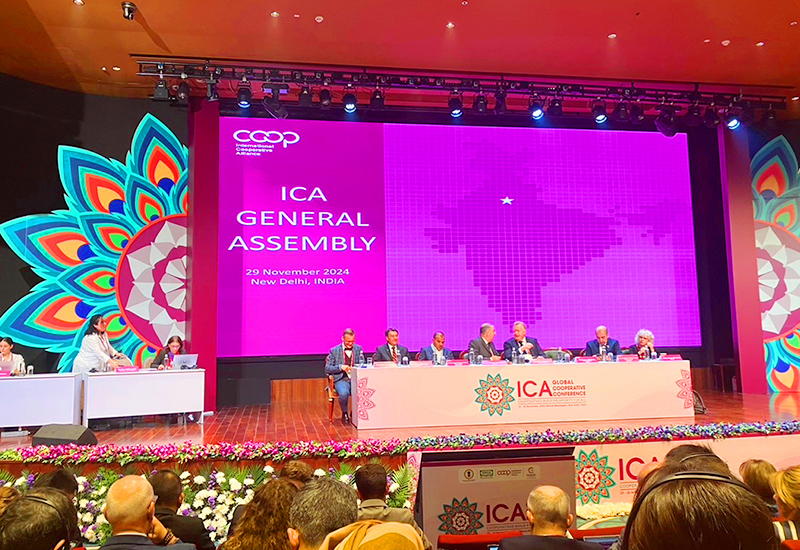
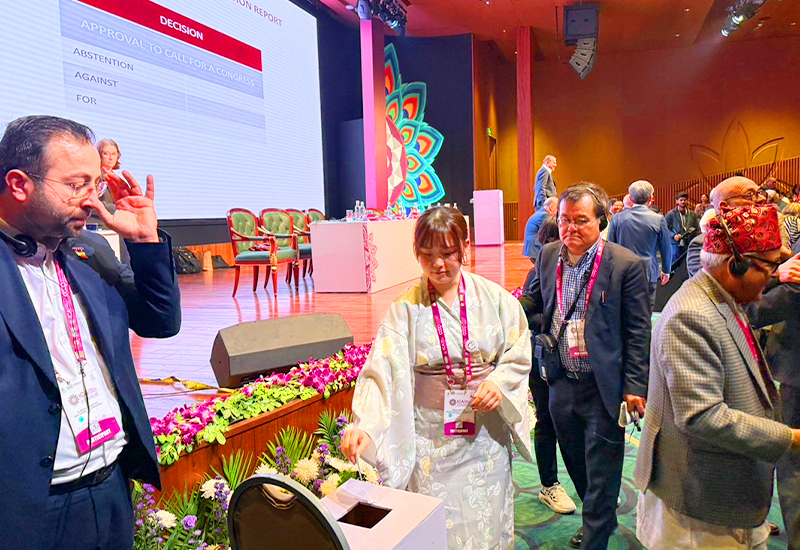
In addition to attending the sessions, we participated in the voting as delegates to the General Assembly.
ICEI Annual Meeting (November 28)
Overview of ICEI
ICA Asia-Pacific Committee on Co-operatives in Educational Institutions (ICEI) was established in 1993 as a subcommittee of the ICA Committee on Consumer Cooperation for Asia and the Pacific (ICA-AP Consumer Committee). Its original aim was to promote the establishment of campus-based co-operatives in order to improve the quality of life on university campuses.
In 2008, at the ICA-AP Regional Assembly held in Hanoi, Vietnam, ICEI became an independent body separate from the ICA-AP Consumer Committee.
The National Federation of University Co-operative Associations (NFUCA), which joined ICA in 2002, played an important role in the establishment of ICEI. Mr. Ichiro Nakamori of NFUCA also served as Vice Chair of ICEI from 2022 to 2024. With the addition of new members from Fiji, Jordan, Nepal, and Vietnam, ICEI currently consists of 30 organizations from 14 countries.
Objectives and Outcomes of the Annual Meeting
The main objectives of ICEI are to promote the development of co-operatives in educational institutions—such as universities, colleges, and secondary schools—whose members include faculty, staff, and students; to provide young people with opportunities to participate directly in co-operative activities; and to deepen understanding of co-operative values, including self-help and mutual assistance.
At the Annual Meeting, participants reviewed activities conducted over the past year and discussed plans looking ahead to 2025. Officer elections were also held during the meeting, and Prof. Shogo Takegawa, President of NFUCA, was elected Chairperson of ICEI for the 2024–2026 term.
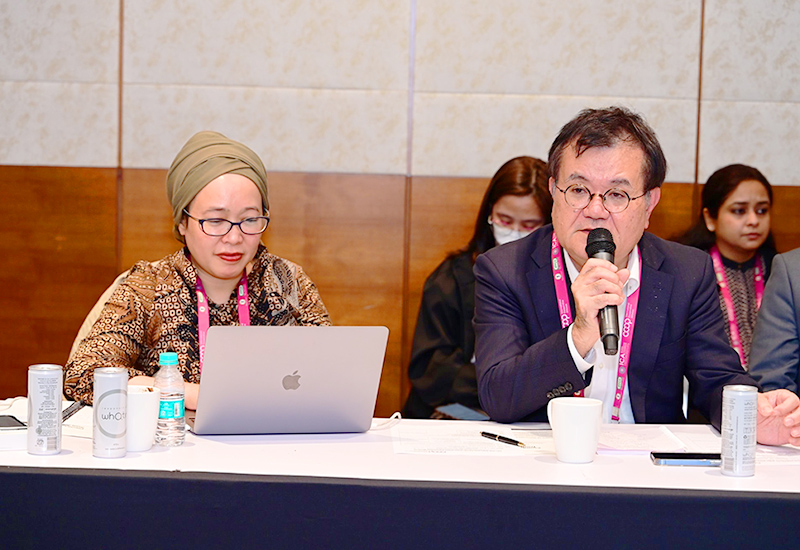
Prof. Takegawa, the elected Chairperson
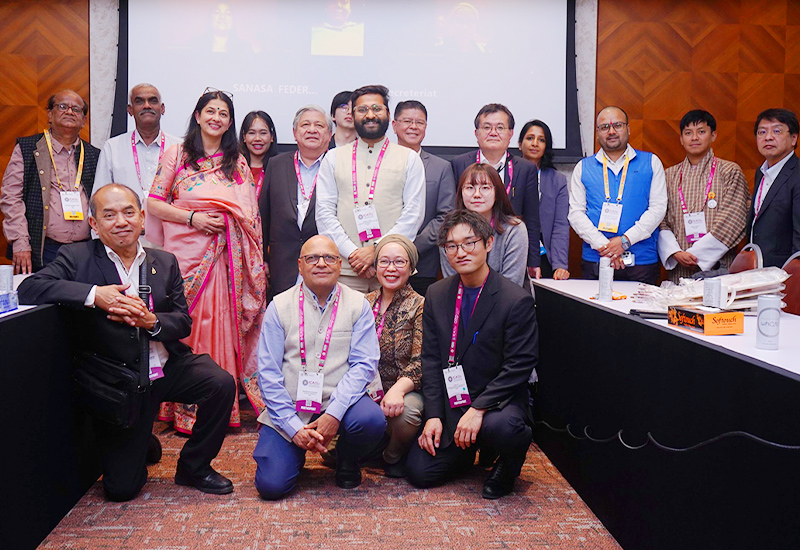
ICEI group photo
Reflections on the Visit
Yuki Kato
What Does “Co-op” Mean to You?
Before the trip, I was concerned that my limited language ability might prevent me from communicating effectively or fully understanding the examples shared during the meetings. When I first arrived in India, I was overwhelmed by the cultural differences and unfamiliar scenery. However, once the ICA General Assembly began, I made up my mind to actively participate, realizing that everyone there had gathered under the shared banner of “co-op.”
Presenting in front of students at Chanakya University and responding to their questions, and listening to case studies from co-operatives around the world during the ICA sessions, made me keenly aware that the role and structure of co-operatives differ greatly from country to country. In particular, I was struck by the fact that in some countries, co-operatives are regarded primarily as a business model built around the concept of cooperation.
However, I believe that for co-operatives to truly contribute to creating a “Better World,” they must be seen not merely as business entities but as communities that improve people’s lives in many aspects, including consumption and daily living. By spreading this broader understanding of co-operatives, individuals can lead more fulfilling lives, ultimately contributing to a better society. I hope that readers will also take this opportunity to reflect on what “co-op” means to them personally.
Junki Ito
The Unique Nature of Student Participation in Japan
During this visit to India, I had two opportunities to speak about the activities of student committee members in Japanese university co-operatives. Through the questions I received, I strongly felt how unique it is for students in Japan to play such an active and leading role in their co-operatives.
Although I learned about co-operatives at universities in other countries, I rarely encountered examples where students themselves take the initiative in leading co-operative activities as they do in Japan. One particularly interesting point raised internationally was how co-operatives could be expanded through university curricula. While co-operative studies already exist in Japan to some extent, hearing these perspectives gave me a fresh insight into how education itself can serve as a vehicle for expanding co-operative values.
The Growing Reach of Co-operative Values
This experience reinforced my belief that student-led engagement is one of the greatest strengths of Japanese university co-operatives. It is also a key element in spreading the co-operative movement globally.
Moreover, participating in the ICA General Assembly allowed me to learn from people involved in various types of co-operatives beyond the fields of “universities” and “daily life.” Despite their different backgrounds, everyone shared a common commitment to improving society through cooperation. This reaffirmed for me the significance of what we do in Japanese university co-operatives, and I hope to continue living and working with the spirit of cooperation at the center of my own life.
Prof. Shogo Takegawa
From November 25 to 30, 2024, I traveled to India together with student staff members Kato, Ito, and Deguchi, along with staff members Shimura and Dina. The purpose of the trip was to attend a seminar at Chanakya University, the ICA General Assembly, and the ICEI Annual Meeting.
Chanakya University is a newly established institution located in Bengaluru, southern India, and construction was still ongoing across the campus. This was the second visit by the NFUCA, but it was my first time visiting both the university and India itself.
The seminar at Chanakya University was made possible through cooperation with Professor Yashavantha Dongre, with whom I had a personal connection from his time as a Japan Foundation Fellow at the University of Tokyo between 2013 and 2014. I had served as his host researcher at the time, and this visit marked our first reunion in over a decade. His research in Japan focused on horizontal integration in microfinance and the significance of Japanese university co-operatives for co-operative development in Asia.
Bengaluru is often referred to as the “Silicon Valley of India,” with many IT companies, including Japanese firms, operating there. Although I had hoped to see more of the city’s development, our tight schedule—arriving late at night and departing immediately after the seminar—made this difficult. Nevertheless, through the seminar, I was able to witness the enthusiasm and rapid development of India’s academic community. The students listened attentively to the presentations by the three Japanese students, reflecting the strong interest in establishing a university co-operative at Chanakya University.
Following the university visit, we traveled to Delhi to attend the ICA General Assembly. The city’s atmosphere reminded me of Tokyo in the 1960s or China shortly after its economic opening, filled with energy, traffic, and constant movement. During the parallel session, Ito presented the activities of Japanese student committees. His presentation was well received, highlighting once again how differently co-operatives operate across countries.
An unexpected development occurred during the ICEI Annual Meeting. On the day before the session, Professor Dongre, who serves as ICEI Co-Secretary, approached me and asked if I would consider running for the position of Chairperson. Though completely unprepared for such a proposal, I was deeply moved when he told me that “the success of NFUCA is a source of hope for Asian countries.” Unable to decline, I accepted the nomination and was subsequently elected Chairperson of ICEI.
Traveling within India required more time than expected, and at times it felt as though we spent more time in transit than at our destinations. This, however, highlighted the sheer scale of the country and its potential for future development.
After completing all scheduled activities, we returned to Japan in the early morning of November 30. The next ICEI meeting is scheduled to be held in Sri Lanka.